I'm afraid to answer the phone when I think it's in English. Awareness of weakness in answering telephone calls in English.
Often used as a listener at international meetings. He can't keep up with speed and tends to be silent.
I feel he isn't saying what he has to say. Often he can't instantly decide what to do. I sometimes wonder if I should have said this at that time.
I can't be active in learning a foreign language I'm worried that the speed of learning a foreign language is slow
A program that satisfies more than one student
0+
A program that satisfies more than one student
0+
J-Global Digital Learning
Are your staff allergic to global communication?
I'm afraid to answer the phone when I think it's in English. Awareness of weakness in answering telephone calls in English.
Often used as a listener at international meetings. He can't keep up with speed and tends to be silent.
I feel he isn't saying what he has to say. Often he can't instantly decide what to do. I sometimes wonder if I should have said this at that time.
I can't be active in learning a foreign language I'm worried that the speed of learning a foreign language is slow
A prescription for overcoming allergies to global communication. That is the Global Communication Mindset.
Communication involves not only language but also various cultural factors in a complex way. I have seen many successful experiences at live seminars where you can fully demonstrate your current language skills by acquiring cross-cultural communication skills and learning the cultural hints behind the language.
John Lynch
Voices of customers who have taken the Global Communication Mindset Program
Voices of customers who have taken the Global Communication Mindset Program
Program structure
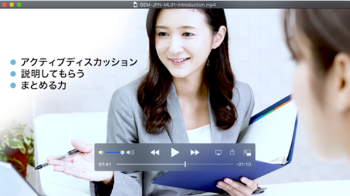
You can expect a high learning effect by improving your learning motivation with your own learning method.
• A bilingual e-learning program where you can learn 20 rules of global communication in 12 hours.
• Consists of 55 micro-lessons divided into 7 modules, first taking the Japanese program and then in English.
• Includes video videos, quizzes and “virtual coach” practice ideas.
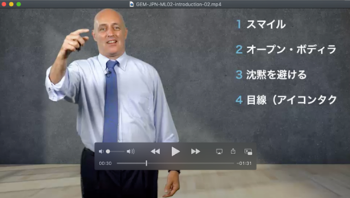
Open communication
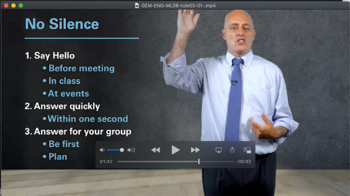
1. Smile 2. Open body language 3. Don’t be silent 4. Eye contact
Persuade
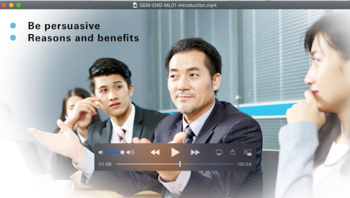
5. Disambiguate 6. Persuasive power 7. Positive attitude 8. Be confident
Think in English
9. Speed learning 10. Interactive 11. Think in English 12. Speak in various expressions
Discussion
13. Think while talking 14. Control the conversation 15. Effectively interrupt 16. Actively participate
Presentation
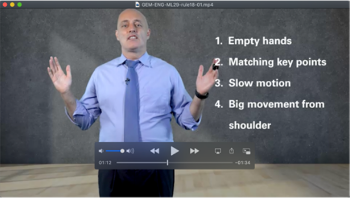
17. Friendly 18. Gesture 19. Front road speaking from the conclusion) 20. Signal
High learning effects can be expected through micro-learning, in which the skills to be acquired are learned one by one for each theme, and active learning, in which learning is centered on two-way exercises.
Micro lesson-composition
Overview
Easy-to-understand lesson outline and summary of learning contents
Video video
Slide video lesson with animation by a cross-cultural communication instructor (3-7 minutes)
Exercise
I will actually try the task. Answers and commentary by the instructor
Finally
Summary of practical advice: One-point advice Reference information about what you have learned, such as books and websites Task: Practice the skills you have learned
next
Next step: See the same module in English. (Easy to think in English and proceed smoothly)
Bilingual course
First of all, study in Japanese and understand the contents firmly. Then you will learn the same content in English. Since I already understand the content, I can understand it well in English Because it is Noh, you can proceed with your studies with confidence.